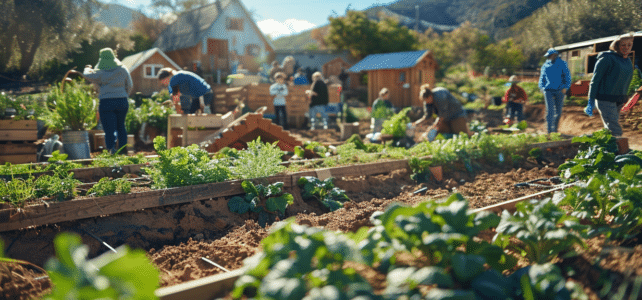
Homeownership represents a fundamental pillar of the dream of stability and personal fulfillment for many individuals around the world. Financial obstacles, particularly the rising real estate prices and increasingly stringent credit criteria, push aspiring homeowners to explore less conventional avenues. From housing cooperatives to tiny homes, participatory housing, or low-cost eco-construction, the range of options is expanding. But between innovative solutions and sometimes utopian promises, you must untangle the feasible from the illusory in the landscape of economic alternatives to acquiring housing.
Economic alternatives for acquiring housing: between innovation and constraints
Economic alternatives and housing acquisition are terms that often go hand in hand today. In Brittany as in Limousin, local initiatives are emerging to counter the housing crisis, some even proposing the house to give away under the condition of renovation or sustainable occupancy. However, this real estate innovation faces administrative constraints and building standards that can deter potential beneficiaries.
For residents of the Basque Country, where tourist appeal drives up prices, cooperative models have emerged, allowing groups of people to share ownership of a home. This collective solution, often praised for its social and solidarity aspect, nevertheless confronts specific home buying constraints unique to each region and the difficulty of reconciling everyone’s interests.
In Moselle, prefabrication and modular housing offer a quick and less expensive response to the growing demand. This real estate innovation is sometimes viewed with skepticism, as prejudices about the quality and durability of these constructions persist despite technological advancements.
Overseas territories, such as French Guiana and New Caledonia, illustrate another facet of economic alternatives for housing. Logistical challenges, the remoteness from decision-making centers, and cultural specificities complicate the application of metropolitan models. Here, the need to innovate intertwines with the imperative to respect often fragile traditions and environments, raising the question of the real adaptability of the proposed solutions in the face of deeply rooted constraints.
The myths and realities of homeownership in a tense market
Myths of homeownership and realities of the real estate market shape the current discourse in a context of often exacerbated real estate tension. Observers, analysts, and industry players regularly confront their perspectives, sometimes alarmist, sometimes optimistic. Political figures like Jean-Luc Mélenchon and Yannick Jadot oppose the exploitation of natural resources such as shale gas, fearing disastrous consequences for the environment and, consequently, for the real estate market. In contrast, personalities like François Fillon and Arnaud Montebourg view mining and energy exploitation as a potential lever for economic revitalization, including for housing.
Organizations such as Friends of the Earth, where Juliette Renaud works as a campaign manager on extractive industries, publish reports that fuel the debate on housing policy. Their work raises questions about the sustainability of economic practices and their impact on housing access. Emmanuel Macron, for example, has promised the opening of new mines in France, an initiative that could indirectly influence the real estate sector, while Manuel Valls, harboring presidential ambitions, may be prompted to take a stance on these major issues.
The real estate tension reflects a complexity that goes beyond the simple framework of ownership. It embodies social aspirations, environmental challenges, and the economic directions of contemporary France. Housing, as a fundamental right and political issue, remains at the heart of citizens’ and decision-makers’ concerns. Economic alternatives for acquiring housing, between dream and pragmatism, continue to generate interest and skepticism, revealing layers of often contradictory realities in a market where balances are fragile.